
Skip to content

Marketing

SEO and PPC: Can They Work Together?

13 min read 📖

SEO and PPC (or Google Ads) are the foundation of any great marketing strategy as they both focus on capturing demand through search.

But, people often wonder how do they work together?

Most customer journeys start with a search engine, just take these statistics from SQ Magazine for example:

“Google holds 90.83% of the global search engine market share.​”
“The average person uses Google 3 to 4 times per day.​”
“81% of shoppers begin their product research on Google.​”

From people looking for comparison guides, to product information, to buying their next home, there’s so many reasons people take to search as their first port of call.

Many brands understand this part and know they need to invest in some form of marketing to help them appear in the search results so people click through to their site.

But, the question many brands ask themselves is:

“Should we choose PPC or SEO?”

This leads to companies treating them both in silo as if they are completely separate tactics.

However:

SEO and PPC work hand-in-hand as they target customers at different stages in the buying journey. By having an integrated approach, you can capture people in both the research stage through organic content and also people in the decision stage (ready to buy) through ads.

Instead of seeing these as separate approaches, this guide is going to explain everything you need to know about SEO and PPC, and most importantly how they support each other to win you more customers.
What Is SEO?

SEO or search engine optimisation involves improvements to your website to enable it to rank in search results. This involves things like:

  • Writing quality content
  • Producing blogs
  • Ensuring a strong linking structure
  • Adding alt text to images
  • Ensuring there are no broken links or 404s
  • Having a clean URL structure
  • Ensuring fast load times
  • Making sure it’s responsive on mobile
  • Having clear calls-to-action
  • Using the correct HTML structure

The aim is to create a strong, user-friendly website so that Google wants to serve your site over others in the search results pages.

For example if you’re a marketing agency like Discovery, people might be looking for the following terms:

“How to design an ecommerce website”
“Why SEO is important for growth”
“What are branding identity services”

Therefore our website needs to convey clear information about the services we offer and how we can help businesses to grow. This is communicated through both website copy on services pages, but also in-depth blogs that explore topics end-to-end.

Strong CTA’s are also key as they give people a clear action to take.

What Is PPC?

PPC or pay-per-click advertising involves the brand paying each time a user clicks on their ad. It literally is ‘pay per click’ as you’re paying to be at the top of Google so that users are more likely to go to your website as your most visible.

PPC works by advertisers bidding on specific keywords to be shown in the auction. This can be competitive, so it relies on adjusting your audience targeting, bidding approach, budget, and ad copy ensuring yours is the most compelling and avoiding ad fatigue.

There are various types of ad campaigns you can run as part of your PPC strategy including:

  • Search
  • Display
  • Shopping
  • Video
  • Performance Max

Companies are often most attracted to PPC as they can make sure their products and services appear at the right moment that users are searching for them. In this instance, PPC gives you immediate visibility and you can capture users who are ready to take action.
Internet browser search bar with magnifier on computer screen with text Search

Benefits of SEO

A key benefit of SEO is that the results compound over time. Whilst it takes time initially, and is labour intensive due to in-depth keyword research and writing long-form content, the results build the longer the content is live.

So whilst it might feel like a hefty upfront investment, you will continue to see and build on the results for years to come. For example, quality blogs will continue to bring people to your website if they continue to answer the questions they’re looking for.

It makes sense to update your content and regularly check it still serves the right intent (for example, shifting from informational to commercial) so that you can stay relevant in the eyes of Google. However this does not mean re-writing the entire blog; it might just need an extra section or updated statistics added.

The great thing is the URL is already live and recognised by Google, so if anything, you’re adding value to what already exists and showing Google that your content is still fresh and relevant.

“While SEO takes time up front, it pays dividends in the long-run. From strengthening the position of your website in search results, to feeding Google high-quality content to serve users, to outperforming your competitors and giving customers a reason to choose you, it builds a strong foundation that only gets stronger over time.”
“While SEO takes time up front, it pays dividends in the long-run. From strengthening the position of your website in search results, to feeding Google high-quality content to serve users, to outperforming your competitors and giving customers a reason to choose you, it builds a strong foundation that only gets stronger over time.”

Amy Johnson - Content Strategist

Benefits of PPC

The main benefit of PPC is the immediate visibility it provides brands. By paying Google to be at the top of the search results, you’re increasing the likelihood of your brand being seen over others in the market.

Furthermore, by bidding on specific high-intent keywords such as:

“The best running trainers”
“Building surveyor near me”
“Holiday homes Scotland”
“Personalised wedding robes”
“Website design Durham”

You’re able to capture people who are in the bottom of the funnel and are ready to take action. Whether that’s filling in a form, making an online enquiry, or making a purchase, they’re ready to take the next step.

This means you’re not burning budget on generalised searches where people are still researching and weighing up their different options. Instead you’re capturing people at the right time, increasing the likelihood of acquiring a customer.

Furthermore, while PPC still involves keyword research, targeting, and building the campaign, the results are much quicker allowing you to make decisions sooner about the best strategies to double down on. With SEO, this can take 3 months or more.

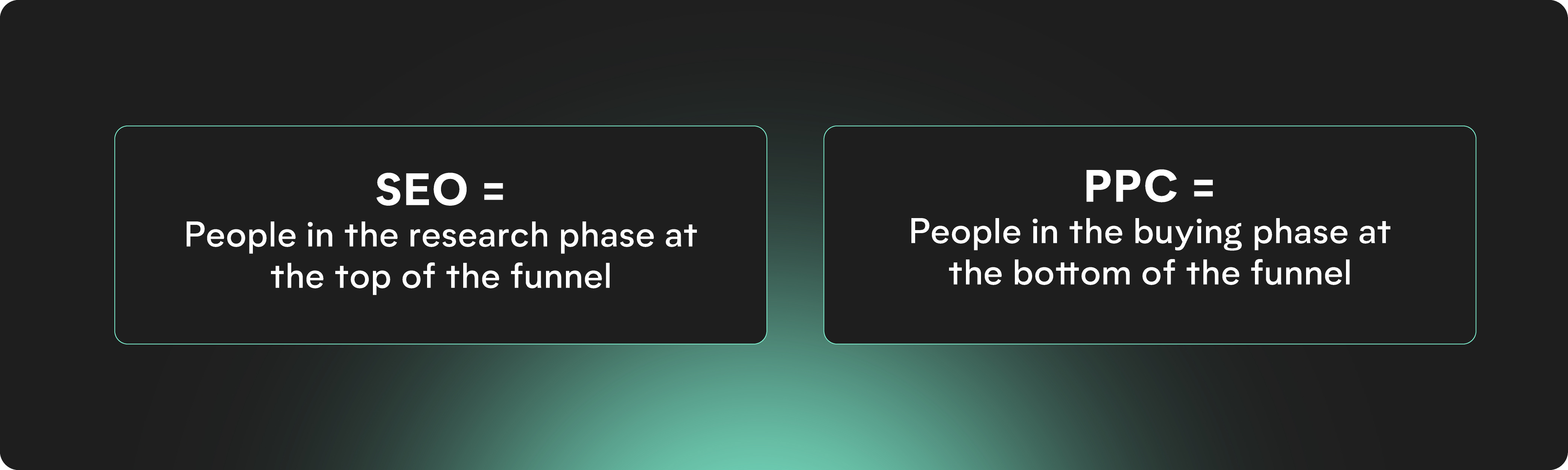
However as you can see, the intent behind people looking for a blog and clicking on an ad are different.

SEO = People in the research phase at the top of the funnel
PPC = People in the buying phase at the bottom of the funnel

So how do we bring these two together so that they work in each other’s favour?

“Whilst SEO builds credibility and trust through rich content, PPC provides highly targeted ads to people who have been through the research journey and are ready to make their purchase or get in touch. A well-structured PPC campaign implements high-intent keywords and data-driven bidding strategies that attract those who have completed the consideration process and are ready to take decisive action.”

Anna Stewart - Digital Marketing Strategist

How SEO and PPC Work Together

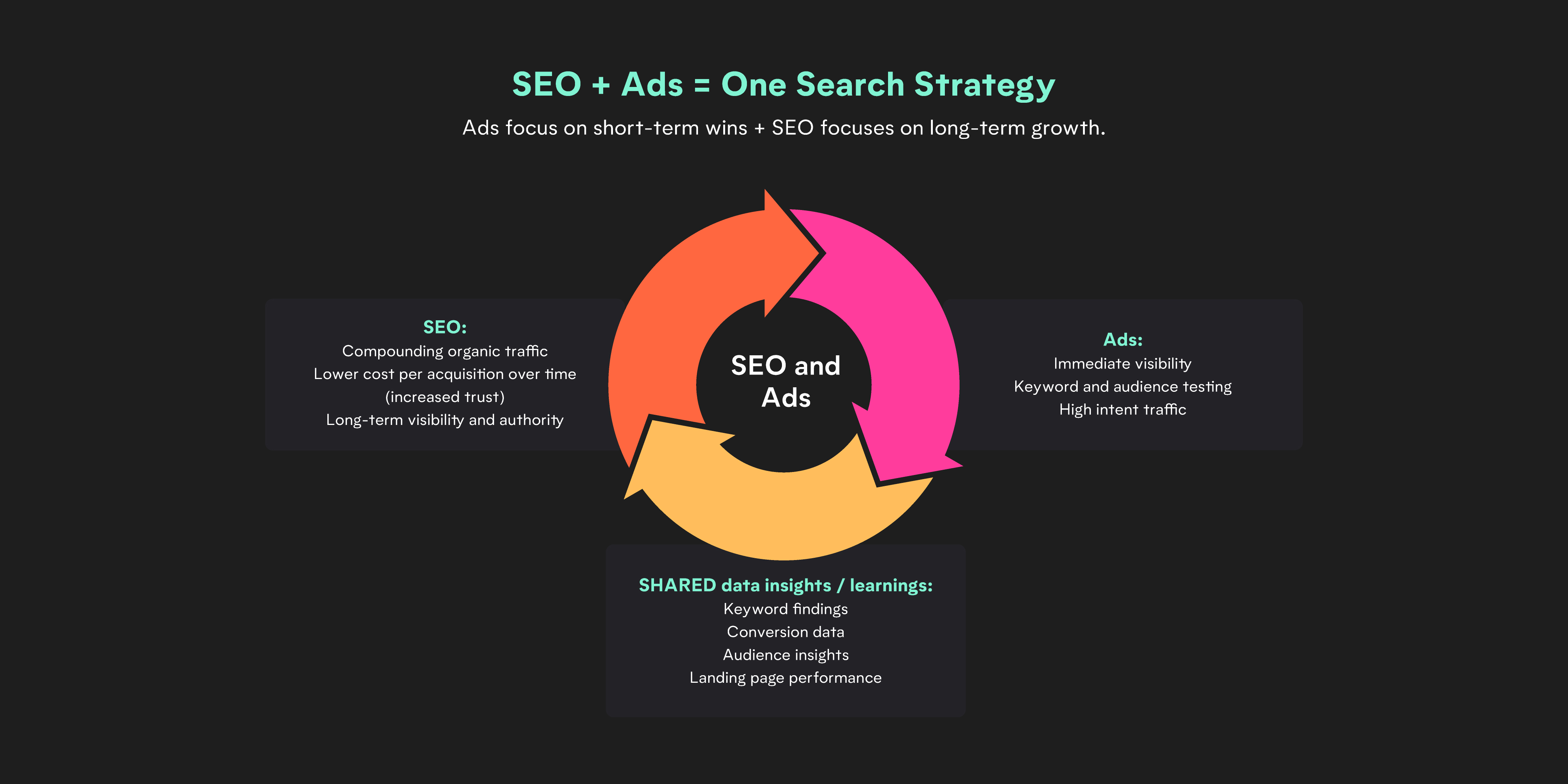
Now that we’ve discussed how SEO and PPC work as marketing strategies of their own, let’s explore how they can (and should) come together. This is often overlooked by brands who keep them separate, missing out on key learnings and opportunities for growth.

This leads us nicely onto our first point.

Shared data and learning

SEO should inform Google Ads and vice versa as both uncover opportunities for new topics and keywords. For example if you have a lettings business, and you’re running a PPC campaign on “flats to rent in Manchester”, you might discover new keywords in the search terms report for “pet-friendly rentals”, “short-term lets Manchester”, and “bills included apartments”.

Using these insights, you can create blog posts on these topics as you know these are things customers are searching for. Furthermore, unlike the ad which can only show short headlines and descriptions, the blog can be much more exploratory, delving deep into the topic and reassuring people of any anxieties.

Likewise, if you’re conducting keyword research for blog titles for a client in the aesthetic industry and notice a lot of search demand for “lip filler cost”, you should test a campaign in Google Ads that targets these keywords.

As you’ve uncovered search demand, it makes sense to use these learnings across both channels as it increases your visibility at different touchpoints and maximises your chances of capturing both quick and long-term demand.

person typing on phone with marketing icons around

Boosts trust

Whilst being at the top of Google with paid ads is highly advantageous as you’re immediately visible, an ad is still an ad. Customers are increasingly savvy and aware of the fact you’ve paid for that placement.

SEO on the other hand is a more accurate reflection of the strength of your content and your website as you’ve not paid to acquire a place. You’ve been positioned on the first page as a result of your SEO efforts which users often see as more trustworthy and credible.

However, by investing in both SEO and Google Ads, users will become more familiar with your brand as you’re positioned in the top, but seeing you in the organic search results will help reaffirm that you’re a brand they can trust.

The most important thing is to target the right queries with both channels as like we discussed earlier, the search intent behind these two channels are different.

Identify long-tail keywords

By using the search terms report, you can uncover new keywords that you might not have considered, some of which might be long-tail. These keywords in particular are valuable as a user has added more detail to their search query.

For instance, using the example of a lettings agency, instead of someone just typing in “lettings agency”, a long-tail search query would be “student lettings agency Manchester”. This allows you to create even more targeted campaigns as you know exactly what they’re looking for.

Anna- could you provide a sentence or two here about the importance of search terms reports in Google Ads and how this can uncover new opportunities please?

Also whilst keyword research is key, the search terms report shows you natural human language patterns and real audience behavior so you can align campaigns more accurately.

Long-tail search queries are great for informing your blog posts as you can integrate these into titles, headers, and calls-to-action.

Optimise landing pages

The strength of the landing pages you link to from Google Ads impacts quality score as Google evaluates things like relevance, page experience, and how well the content matches the user’s search intent.

Therefore it’s important your landing pages are valuable and informative, providing a smooth user experience that encourages people to take action. These pages are the bridge between your ad and someone actually getting in touch or making a purchase.

As such, they need to be strong and compelling.

This involves reviewing:

  • Website copy
  • Structure
  • Images/ videos
  • Social proof
  • Calls-to-action

This is where SEO and PPC support each other as SEO insights help shape landing page content around what users are searching for, while PPC provides real-time performance data to identify what’s working and what isn’t.

Broader audience targeting across the sales funnel

As discussed, SEO and PPC target different types of search intent, meaning they reach users at different stages of the buying journey. While some users are ready to convert immediately, many aren’t as people often research, compare options, visit multiple websites, and return to Google several times before making a decision.

This is where combining both channels becomes powerful. PPC captures high-intent users and supports time-sensitive campaigns such as promotions or seasonal offers ensuring quick delivery and traffic.

In contrast, SEO focuses on building long-term visibility, helping you attract users earlier in their journey when they’re still researching, bringing in a steady stream of visitors.

By combining the power of SEO and PPC, businesses can engage users through all stages of the funnel, from research and discovery, through to conversion.

SEO and PPC FAQs

How long does SEO take?

SEO takes time initially as you need to focus on improvements to your site such as writing quality content, building strong links, and creating a smooth user experience. Results can take up to 3 months to see, but then they continue to build momentum the longer content is live.

What are the main benefits of PPC?

PPC provides immediate visibility by bidding on specific keywords that are relevant to your business. This means you’re paying to be at the top of Google so users are more likely to click on your ad and through to your website. Another advantage is quick, accurate results as you can soon see what’s working and what’s not.

Who should I hire to manage my SEO and PPC?

To maximise the impact of your SEO and PPC strategy it’s recommended to hire a professional agency who specialises in both of these services. This way, you can be confident they understand the power of both marketing channels and most importantly, how to make them work together. At Discovery Design, we offer both SEO and Google Ads allowing you to leverage both channels whilst benefitting from shared insights and opportunities.

SEO and PPC: Can They Work Together?

After reading this blog, you’ve hopefully discovered the different ways SEO and PPC can work together to create a full-funnel marketing strategy.

By targeting users at different stages of the funnel, and by sharing the insights learned from both strategies, you can create an informed, comprehensive strategy that captures users throughout their entire journey.

Instead of treating these activities in silo, bringing them together allows you to leverage the power of both ensuring you’re capturing short-term wins whilst still investing in the long-term growth of your business.

At Discovery Design, we have specialists in both Google Ads and SEO giving you peace of mind that both channels will be well executed. As we manage these both in-house, your business will also business from shared data and learnings that we can use to inform future campaigns. Get in touch with our marketing team to find out how we can help.

Speak to Our Marketing Team

We have dedicated specialists in SEO and PPC so we can used shared learnings for maximum impact.

Amy Johnson

Content Strategist

Insights

Check out more